Rhinoceros: A Deep Dive into Ionesco’s Play
Ionesco’s Rhinoceros, readily available as a PDF, dissects societal conformity through a bizarre transformation, exploring themes of existentialism and totalitarian pressures.
Overview of Eugène Ionesco and the Theatre of the Absurd
Eugène Ionesco, a Romanian-French playwright, stands as a pivotal figure in the Theatre of the Absurd. His works, often available as a PDF for scholarly study, challenge conventional dramatic structures and explore the meaninglessness of existence. Ionesco rejected realistic representation, favoring illogical dialogue and bizarre scenarios to reflect the alienation of modern life.
His plays, including Rhinoceros, dismantle language and reason, exposing the anxieties of a post-war Europe grappling with conformity and the threat of totalitarianism. The Absurd isn’t simply nihilism; it’s a recognition of the inherent chaos and lack of inherent purpose in the human condition, powerfully conveyed through his unique dramatic style.
Historical Context of Rhinoceros (1959)
Premiering in 1959, Rhinoceros emerged from a post-World War II Europe still reeling from the horrors of fascism and the looming threat of the Cold War. The play, often found as a downloadable PDF, reflects anxieties surrounding political extremism and the ease with which individuals succumb to mass movements. Ionesco witnessed the rise of totalitarian regimes firsthand, fueling his exploration of conformity and the loss of individuality.
The play isn’t a direct allegory, but rather a metaphorical response to the pressures of ideological conformity and the dangers of unchecked power. It captures a pervasive sense of unease and the fear of losing one’s identity within a rapidly changing and increasingly homogenized world, readily available for analysis in its PDF form.
Character Analysis
Exploring characters like Berenger, Jean, and Daisy – readily available in the Rhinoceros PDF – reveals Ionesco’s commentary on conformity, ambition, and the struggle for identity.
Berenger: The Protagonist’s Journey
Berenger, central to Ionesco’s Rhinoceros – easily accessed as a PDF – embodies the reluctant hero facing a world consumed by conformity. Initially indifferent and somewhat slovenly, he represents the average man, slow to recognize the escalating absurdity around him. As colleagues and friends transform into rhinoceroses, Berenger’s journey becomes a desperate struggle to maintain his humanity.
The PDF reveals his internal conflict: a desire to fit in versus a growing awareness of the dangers of mass hysteria. He attempts to emulate the transformation, highlighting his vulnerability, but ultimately chooses resistance, becoming the last man standing. Berenger’s arc is a poignant exploration of existential angst and the courage required to remain true to oneself.
Berenger’s Initial Indifference and Gradual Awakening
The Rhinoceros PDF showcases Berenger’s initial state as apathetic and unconcerned with societal norms. He’s presented as a man lost in his own world, seemingly oblivious to the burgeoning chaos. This indifference is crucial; it mirrors the complacency Ionesco critiques. However, as the rhinoceros transformation spreads – vividly depicted in the PDF – Berenger’s awareness slowly dawns.
He witnesses the loss of individuality in those around him, prompting a gradual awakening. This isn’t a sudden realization, but a creeping dread as he grapples with the implications of mass conformity. The PDF highlights his struggle to comprehend the absurdity, marking the beginning of his internal conflict.
Berenger’s Struggle to Maintain Humanity
As detailed in the Rhinoceros PDF, Berenger’s central conflict revolves around preserving his humanity amidst overwhelming conformity. He’s increasingly isolated as friends and colleagues succumb to the transformation, becoming monstrous representations of societal pressure. The PDF emphasizes his desperate attempts to cling to reason and individuality, even as the world around him descends into absurdity.
His struggle isn’t merely philosophical; it’s a visceral fight against a primal urge to join the herd. The PDF illustrates his internal turmoil, showcasing moments of weakness where he almost yields. Ultimately, Berenger’s resistance, though lonely, embodies a defiant assertion of human values.
Jean: The Ambitious Conformist
The Rhinoceros PDF portrays Jean as a stark contrast to Berenger – a character driven by ambition and a relentless pursuit of success. He embodies the dangers of prioritizing societal approval over individual integrity. As the PDF reveals, Jean’s perfectionism fuels his desire to excel, making him particularly susceptible to the allure of the rhinoceros transformation.
He views the change as an opportunity for advancement, a way to become “better” and more efficient. The PDF highlights his calculated embrace of conformity, demonstrating how easily ambition can be corrupted by mass hysteria and the promise of power.
Jean’s Perfectionism and Desire for Success
The PDF version of Rhinoceros meticulously details Jean’s character, revealing a man obsessed with upholding standards and achieving professional recognition. His perfectionism isn’t rooted in genuine quality, but rather a desperate need for validation. As the PDF illustrates, he constantly judges others, particularly Berenger, for perceived shortcomings.
This relentless drive for success makes him vulnerable to the seductive logic of the rhinoceros transformation. The PDF emphasizes that Jean sees conformity not as a loss of self, but as a pathway to advancement, a way to finally meet his own impossibly high expectations.
Jean’s Transformation and its Significance
The PDF of Ionesco’s Rhinoceros portrays Jean’s transformation as a chilling illustration of ambition overriding morality. Unlike others, his shift isn’t impulsive; it’s a calculated decision, detailed within the PDF, to embrace power and efficiency as embodied by the rhinoceroses.
This metamorphosis signifies the dangers of prioritizing success above all else. The PDF highlights how Jean willingly sacrifices his individuality, believing conformity will unlock his potential. His transformation isn’t merely physical; it’s a complete surrender of his values, a stark warning against unchecked ambition, readily available for study in the play’s PDF format.
Daisy: The Object of Affection and Conformity
As detailed in the readily available Rhinoceros PDF, Daisy represents a complex interplay between affection and societal pressure. Berenger’s persistent, respectful address of her as “Miss Daisy” underscores his genuine feelings, yet the PDF reveals her eventual succumbing to the rhinoceros transformation.
Initially, the PDF shows Daisy attempts resistance, mirroring a desire to maintain individuality. However, the allure of belonging and the overwhelming momentum of conformity prove too strong. Her ultimate abandonment of Berenger, explicitly documented in the play’s PDF, symbolizes the fragility of human connection when faced with mass hysteria and the seductive power of assimilation.
Daisy’s Initial Resistance
The Rhinoceros PDF clearly illustrates Daisy’s early attempts to defy the escalating transformation. She actively “puts up a good fight,” as noted within the play’s text, available in PDF format, demonstrating a conscious effort to preserve her humanity amidst the growing absurdity. This resistance, highlighted in the PDF, isn’t merely physical; it’s a struggle to maintain her identity and values.
However, the PDF also subtly reveals the limitations of her defiance. Surrounded by increasingly transformed individuals, her resistance feels increasingly isolated and futile. The PDF’s narrative suggests her initial strength is gradually eroded by the sheer force of conformity, foreshadowing her eventual surrender, a key element detailed within the complete PDF version.
Daisy’s Ultimate Succumbence to the Rhinoceros Transformation
As detailed in the readily available Rhinoceros PDF, Daisy’s initial resistance tragically collapses. The PDF explicitly states she is “attracted to them and abandons (and repudiates) Berenger,” signifying a complete surrender to the collective transformation. This shift, thoroughly documented within the PDF’s script, isn’t presented as a violent coercion, but rather a willing embrace of the rhinoceros form.
The PDF portrays this succumbing as a commentary on the allure of belonging and the ease with which individuality can be sacrificed for acceptance. Her abandonment of Berenger, clearly outlined in the PDF, underscores the devastating consequences of unchecked conformity, a central theme explored throughout the play’s PDF version.
Themes Explored in Rhinoceros
The Rhinoceros PDF vividly portrays conformity, loss of self, totalitarian dangers, and existential questioning, prompting reflection on societal pressures and individual identity.
Conformity and Mass Hysteria
The readily accessible Rhinoceros PDF powerfully illustrates the dangers of unchecked conformity and the rapid spread of mass hysteria within a society. Ionesco depicts citizens inexplicably transforming into rhinoceroses, symbolizing a surrender to collective thought and behavior. This transformation isn’t forced, but desired, highlighting a disturbing willingness to abandon individuality for belonging.
The play explores how easily individuals succumb to group pressure, prioritizing acceptance over critical thinking. Jean, initially a stickler for standards, exemplifies this, eagerly embracing the change for perceived advancement. The escalating trampling represents the overwhelming force of this collective madness, leaving Berenger as a lone voice of resistance against the tide of conformity. The PDF allows for close study of this chilling depiction of societal breakdown.
The Loss of Individuality
Examining the Rhinoceros PDF reveals a central theme: the erosion of individuality in the face of overwhelming societal pressure; As characters transform, they relinquish their unique human qualities, becoming part of a homogenous, monstrous collective. This isn’t merely a physical change; it’s a spiritual and intellectual surrender.
Berenger’s struggle embodies this loss, as he desperately clings to his humanity while witnessing friends and colleagues abandon theirs. The play suggests that conformity isn’t simply about adopting similar beliefs, but about losing the capacity for independent thought. The PDF facilitates a detailed analysis of how Ionesco portrays this tragic diminishment of self, highlighting the importance of resisting assimilation into the herd.
The Dangers of Totalitarianism
A close reading of the Rhinoceros PDF unveils a potent allegory for the dangers of totalitarian regimes. The rhinocerization represents the seductive allure of mass movements and the suppression of dissent. The play doesn’t depict a traditional dictatorship, but a more insidious form of control – one achieved through voluntary conformity and the abandonment of critical thinking.
Ionesco, through this PDF-accessible work, warns against the ease with which individuals can be swept up in ideologies that demand absolute obedience. The escalating trampling symbolizes the crushing of individuality under the weight of a collective will. The play serves as a chilling reminder of the importance of safeguarding freedom and resisting all forms of oppressive power.
Existentialism and the Search for Meaning
Examining the Rhinoceros PDF reveals profound existential themes. Berenger’s struggle to remain human amidst the rhinocerization embodies the individual’s search for meaning in an absurd world. The play questions the nature of identity and the pressures to conform, forcing characters – and the audience – to confront their own values.
Ionesco, through this readily available PDF, portrays a universe devoid of inherent purpose, where individuals must define their own essence. Berenger’s final stand isn’t a triumph, but a defiant assertion of self in the face of oblivion. The play’s ambiguity compels readers to grapple with the complexities of existence and the responsibility of choice.
Plot Summary and Structure
The Rhinoceros PDF details a town succumbing to a bizarre transformation, unfolding in three acts as citizens become rhinoceroses, leaving Berenger as the last man.
Act I: The Initial Outbreak
As revealed in the Rhinoceros PDF, Act I establishes a seemingly normal setting disrupted by the sudden appearance of a rhinoceros. Initially, this event is met with curiosity and mild amusement by the townspeople. However, the frequency of rhinoceros sightings rapidly increases, escalating from a novelty to a growing concern.
The initial transformations begin subtly, with characters exhibiting rhinoceros-like tendencies before physically changing. Jean, a meticulous and ambitious colleague of Berenger, displays early signs of embracing the transformation, driven by a desire for efficiency and success. Berenger, in contrast, remains largely indifferent, observing the unfolding chaos with a detached bemusement. This act lays the groundwork for the escalating mass hysteria and the central conflict of the play, showcasing the initial stages of conformity’s insidious spread.
Act II: The Spread of the Transformation
The Rhinoceros PDF details how Act II witnesses an alarming acceleration of the rhinoceros transformation, engulfing more and more of the town’s population. The trampling becomes overwhelming, symbolizing the crushing force of conformity. Characters who initially resisted, like Daisy, begin to succumb to the allure of the transformation, drawn in by its promise of belonging and power.
Jean’s complete metamorphosis exemplifies this shift, showcasing his ambition and perfectionism twisted into a monstrous form. Berenger finds himself increasingly isolated, struggling to comprehend the widespread acceptance of this bizarre phenomenon. The act highlights the terrifying speed with which mass hysteria can take hold, eroding individuality and critical thought, leaving Berenger as a lone voice of dissent.
Act III: Berenger’s Final Stand
As detailed in the Rhinoceros PDF, Act III presents Berenger as the last remaining human, desperately clinging to his identity amidst a world overrun by rhinoceroses. He attempts, and fails, to transform himself, realizing his inability to join the mindless herd. This failure, however, sparks a renewed determination to resist.
Berenger declares his intention to stand against the creatures, a symbolic act of defiance against conformity and totalitarianism. He embodies the struggle to maintain individuality in the face of overwhelming pressure. The act culminates in a powerful, albeit lonely, assertion of humanity, leaving the audience to ponder the fate of independent thought.
Symbolism and Imagery
The Rhinoceros PDF reveals the rhinoceros itself embodies conformity, while the physical transformation symbolizes the loss of individuality and critical thought.
The Rhinoceros as a Symbol of Conformity
Examining the Rhinoceros PDF, the rhinoceros transcends a mere animalistic presence, becoming a potent symbol of mindless conformity and the dangers of succumbing to collective hysteria. As citizens transform, they embrace a brutish, unthinking existence, mirroring the ease with which individuals abandon their unique identities for group acceptance.
This transformation isn’t presented as inherently evil, but rather as a seductive pull towards simplicity and belonging. The rhinoceros represents a rejection of nuance, critical thinking, and individual responsibility. Ionesco utilizes this imagery to critique the societal pressures that encourage individuals to relinquish their autonomy and blindly follow the herd, highlighting the terrifying potential for mass movements to erase individuality.
The Physical Transformation as a Metaphor
Within the Rhinoceros PDF, the escalating physical metamorphosis serves as a striking metaphor for the erosion of human values and the insidious creep of totalitarian ideologies. The characters’ gradual conversion into rhinoceroses isn’t merely a fantastical event; it visually embodies the loss of individuality, empathy, and intellectual curiosity.
This bodily change represents a descent into primal instincts, a rejection of reason, and an embrace of brute force. Ionesco cleverly uses the rhinoceros’s imposing physique to symbolize the overwhelming power of conformity, demonstrating how easily individuals can be crushed under the weight of societal pressure. The transformation is a chilling depiction of dehumanization.
The Setting and its Contribution to the Play’s Atmosphere
Examining the Rhinoceros PDF reveals how Ionesco masterfully employs a deliberately mundane and initially unremarkable setting to amplify the play’s unsettling atmosphere. The action unfolds in a typical town square, a commonplace locale that quickly becomes a stage for extraordinary and disturbing events. This normalcy heightens the sense of dread as the rhinoceros transformations begin, making the absurd feel disturbingly plausible.
The lack of specific geographical or historical markers contributes to the play’s universality, suggesting that this descent into conformity could occur anywhere. The increasingly chaotic environment, mirroring the escalating transformations, reinforces the themes of societal breakdown and the loss of control.

Critical Interpretations
Analyzing the Rhinoceros PDF, Harold Bloom’s essays offer insightful perspectives on Ionesco’s work, particularly regarding existential themes and post-war European anxieties.
Harold Bloom’s Analysis of Ionesco’s Work
Bloom’s critical assessment, accessible when studying the Rhinoceros PDF, positions Ionesco as a pivotal figure in 20th-century drama. He emphasizes Ionesco’s masterful use of the absurd to expose the anxieties of modern existence. Bloom delves into the play’s allegorical layers, interpreting the rhinoceros transformation as a potent symbol of ideological conformity and the erosion of individual identity.
He highlights how Ionesco challenges conventional dramatic structures, employing repetitive dialogue and illogical scenarios to create a disorienting and unsettling experience for the audience. Bloom’s analysis also explores the play’s engagement with existentialist philosophy, particularly the themes of alienation, meaninglessness, and the search for authenticity in a chaotic world. Ultimately, Bloom views Rhinoceros as a profound and enduring work of art that continues to resonate with contemporary audiences.
The Play’s Relevance to Post-War Europe
Examining the Rhinoceros PDF reveals its striking resonance with the socio-political climate of post-war Europe. The play powerfully reflects the anxieties surrounding the rise of totalitarian ideologies and the pervasive pressure to conform. The mass transformation into rhinoceroses mirrors the spread of fascism and communism, where individuality was suppressed in favor of collective identity.
Ionesco’s work captured the widespread fear of losing personal freedom and the dangers of unchecked political power. The play’s absurdist style served as a critique of the irrationality and dehumanization inherent in these systems. It resonated deeply with a continent grappling with the aftermath of war and the threat of renewed conflict, making it a significant cultural touchstone.
Connections to Other Works
The Rhinoceros PDF highlights parallels with Dr. Jekyll and Mr. Hyde and M. Butterfly, exploring themes of transformation and societal pressures.
Similarities to Dr. Jekyll and Mr. Hyde
Examining the Rhinoceros PDF reveals striking thematic resonances with Robert Louis Stevenson’s Dr. Jekyll and Mr. Hyde. Both works explore the duality of human nature and the terrifying potential for inner transformation. While Jekyll’s change is internal, manifesting as a monstrous alter ego, Ionesco’s characters undergo a visible, physical metamorphosis into rhinoceroses.
However, both transformations symbolize a loss of control and a descent into primal instincts. The societal acceptance of the rhinoceros transformation in Ionesco’s play mirrors the Victorian era’s repression and hidden vices explored in Stevenson’s novel. Both narratives question the fragility of civilization and the ease with which individuals can succumb to base desires, highlighting anxieties about societal norms and the dark side of humanity.
Parallels with M. Butterfly
A close reading of the Rhinoceros PDF alongside David Henry Hwang’s M. Butterfly reveals compelling parallels concerning illusion, identity, and societal expectations. Both plays challenge conventional notions of reality and explore the dangers of projecting desires onto others. In M. Butterfly, a Western diplomat misinterprets a Chinese opera singer’s gender, while in Rhinoceros, characters willingly embrace a monstrous form.
Both works demonstrate how individuals can be blinded by their own preconceptions and desires, leading to tragic consequences. The theme of transformation—both physical and psychological—is central to both narratives, questioning the very nature of self and the performative aspects of identity within restrictive social structures.
Influence on Modern Drama
Examining the Rhinoceros PDF reveals its profound impact on modern dramatic literature. Ionesco’s innovative use of the absurd, coupled with its potent political allegory, paved the way for playwrights to experiment with form and content. The play’s exploration of conformity and the loss of individuality resonated deeply with post-war audiences and continues to inspire contemporary works.
Its influence can be seen in plays that challenge societal norms and explore themes of alienation and existential angst. Rhinoceros encouraged a shift away from traditional realism, embracing a more fragmented and symbolic approach to storytelling, fundamentally altering the landscape of theatrical expression.
The Play’s Enduring Legacy
The readily accessible Rhinoceros PDF ensures Ionesco’s warning against conformity persists, sparking ongoing discussions and innovative performances globally, remaining strikingly relevant.
Rhinoceros in Contemporary Performance
The enduring power of Ionesco’s Rhinoceros is vividly demonstrated through its continued presence on stages worldwide, often facilitated by easily accessible PDF versions of the script. Modern productions frequently emphasize the play’s chilling parallels to contemporary political and social climates, resonating with audiences grappling with issues of mass movements and individual resistance. Directors often employ innovative staging techniques – incorporating multimedia, physical theatre, and stark visual designs – to amplify the absurdist nature of the transformation and the escalating sense of societal breakdown.
These interpretations frequently explore the psychological toll of conformity, highlighting Berenger’s desperate struggle to maintain his humanity amidst a world succumbing to bestial instincts. The availability of the play as a PDF allows for widespread study and adaptation, fostering a dynamic and evolving legacy for this seminal work of the Theatre of the Absurd;
The Play’s Continued Relevance in the 21st Century
Ionesco’s Rhinoceros, readily available as a PDF, maintains striking relevance in the 21st century, mirroring anxieties surrounding political polarization, the spread of misinformation, and the erosion of individual thought. The play’s depiction of mass hysteria and unquestioning conformity feels particularly prescient in an age of social media echo chambers and viral trends. The ease of access provided by the PDF format encourages critical engagement with its themes, prompting discussions about the dangers of groupthink and the importance of independent reasoning.
Furthermore, the play’s exploration of existential angst continues to resonate with a generation grappling with uncertainty and a search for meaning in a rapidly changing world.
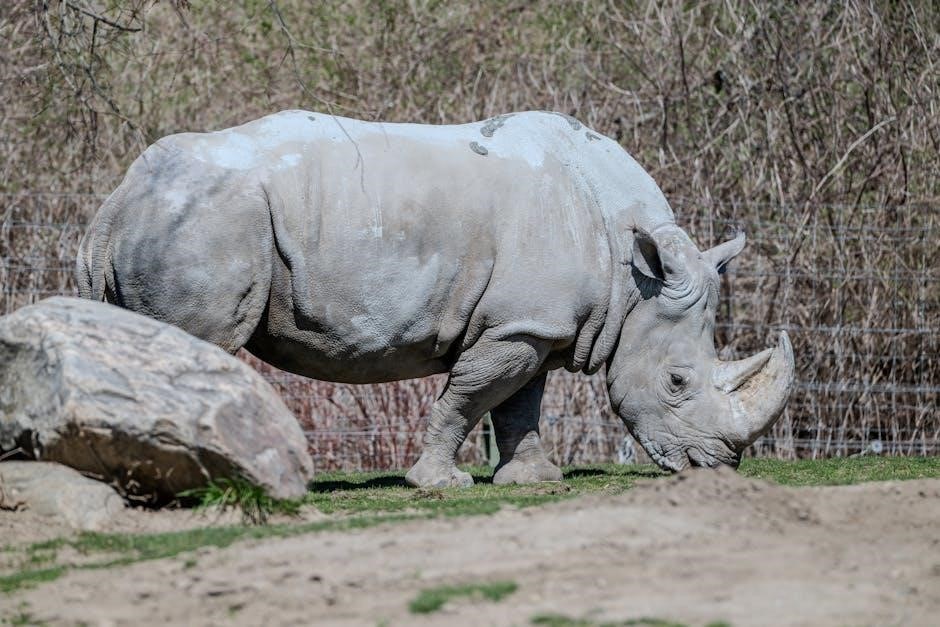
White Rhinoceros (Ceratotherium simum) ー A Biological Note
While Ionesco’s Rhinoceros is a play, readily found as a PDF, the white rhinoceros faces real threats, demanding conservation efforts for its survival.
Behavioral Ecology of White Rhinoceros
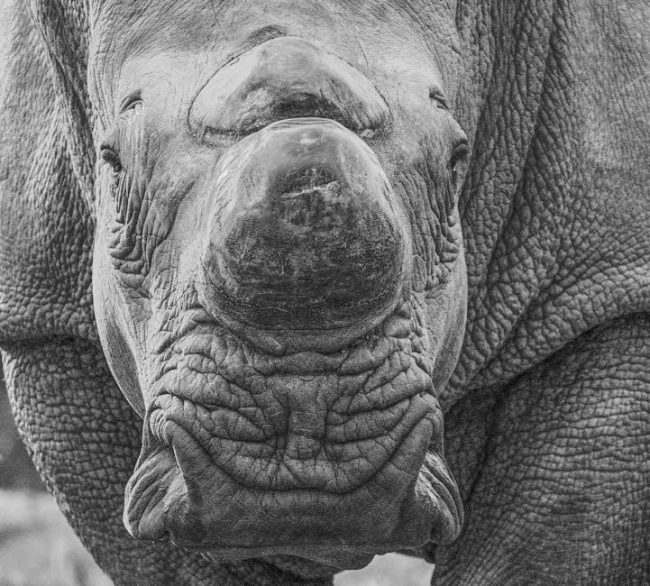
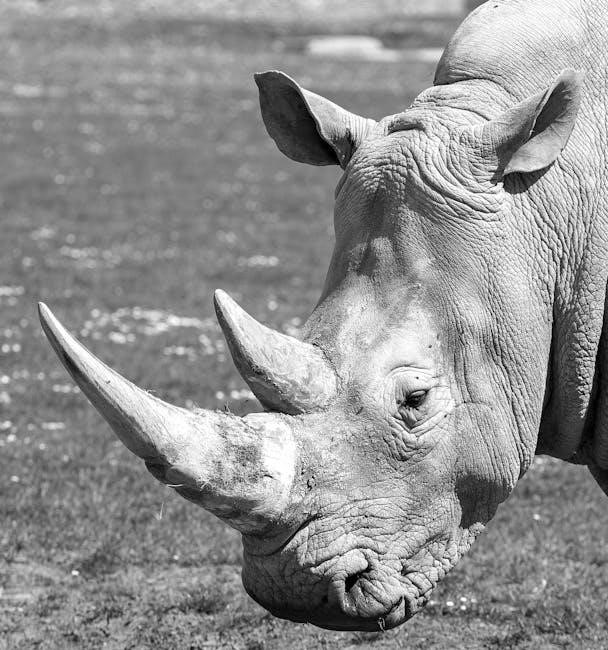
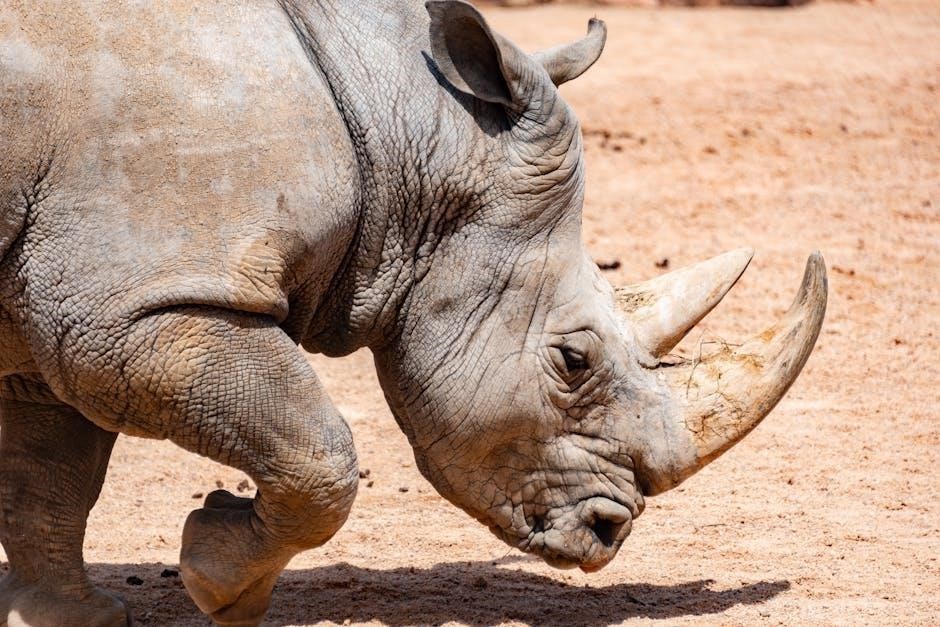
Interestingly, while Eugène Ionesco’s play, often accessed as a PDF, utilizes the rhinoceros as a potent symbol of conformity and societal collapse, the actual behavioral ecology of Ceratotherium simum is remarkably complex. These creatures exhibit social behaviors, often forming small groups, though solitary living is also common. Their interactions are governed by dominance hierarchies, particularly amongst males competing for mating opportunities.
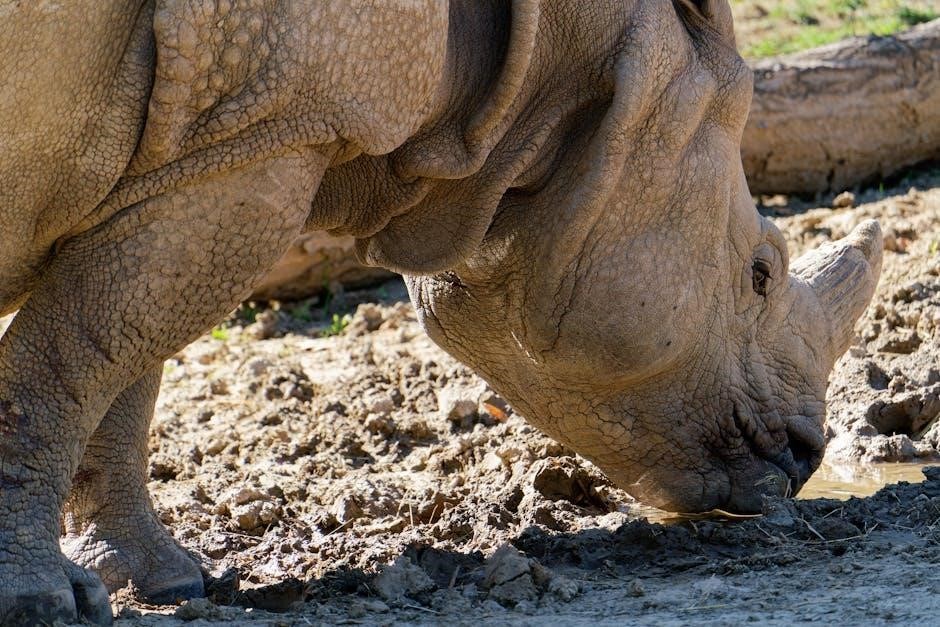
White rhinos are grazers, consuming large quantities of grass daily, influencing vegetation patterns. They rely heavily on wallowing in mud to regulate body temperature and protect their skin from parasites. Understanding these behaviors is crucial for effective conservation, especially given the play’s metaphorical resonance with human societal pressures.
Conservation Status and Threats
Despite the symbolic weight of the rhinoceros in Ionesco’s play – frequently studied via readily available PDF versions – the real-world conservation status of these magnificent animals is precarious. White rhinoceroses are classified as “Near Threatened” by the IUCN, facing significant threats primarily from poaching driven by demand for their horns in traditional medicine.
Habitat loss due to agricultural expansion and human settlement also contributes to their decline. Intensive conservation efforts, including anti-poaching patrols and translocation programs, are vital for their survival. The play serves as a stark reminder of the potential for collective destruction, mirroring the threats faced by these animals.